Advanced Orchestration: Agent Frameworks & Foundation Models
Nasir Mahmood Abbasi, PhD
Bioinformatics Educator
Learning Objectives & Prerequisites
- Prerequisites: Proficiency in Python and a fundamental understanding of how LLM APIs (OpenAI, Anthropic) operate.
- Objective: Learn to utilize agentic frameworks to orchestrate multi-step bioinformatics pipelines autonomously.
- Expected Output: A conceptual and practical understanding of setting up a multi-agent system using LangGraph.
📘 The Shift to Multi-Agent Orchestration
Single prompt LLMs are powerful, but they struggle with long-horizon, multi-step tasks like running a Nextflow pipeline, debugging the errors, and summarizing the results. Multi-agent orchestration solves this by assigning specific roles (e.g., Coder, Reviewer, Executor) to different agents that collaborate to achieve a goal.
Before You Begin: Install the Frameworks in an Isolated Environment
LangGraph and AutoGen are orchestration frameworks, not biological validators. Use a separate environment, pin versions after testing, and keep provider credentials outside the repository.
python3 -m venv .venv
source .venv/bin/activate
python -m pip install --upgrade pip
python -m pip install langgraph autogen-agentchat
python -c "import langgraph; print('LangGraph: OK')"
python -m pip freeze > requirements.lock.txt
Begin with one deterministic tool and one reviewer agent. Add biological foundation models only after you can trace the graph state, retry behavior, tool permissions, and final output. Set explicit budgets for tokens, time, and external calls.
Success check: the workflow produces the same structured output on a toy input, exposes its intermediate states, and stops when a reviewer rejects an unsafe or unsupported result.
Biological Foundation Models
The next frontier in computational biology involves utilizing foundation models such as ESM3 for protein design, scGPT for single-cell embeddings, and AlphaFold 3 for structural prediction. These models often require complex API orchestration to batch process sequences or single-cell data, making manual interaction tedious.
Using Agent Frameworks (LangGraph & AutoGen)
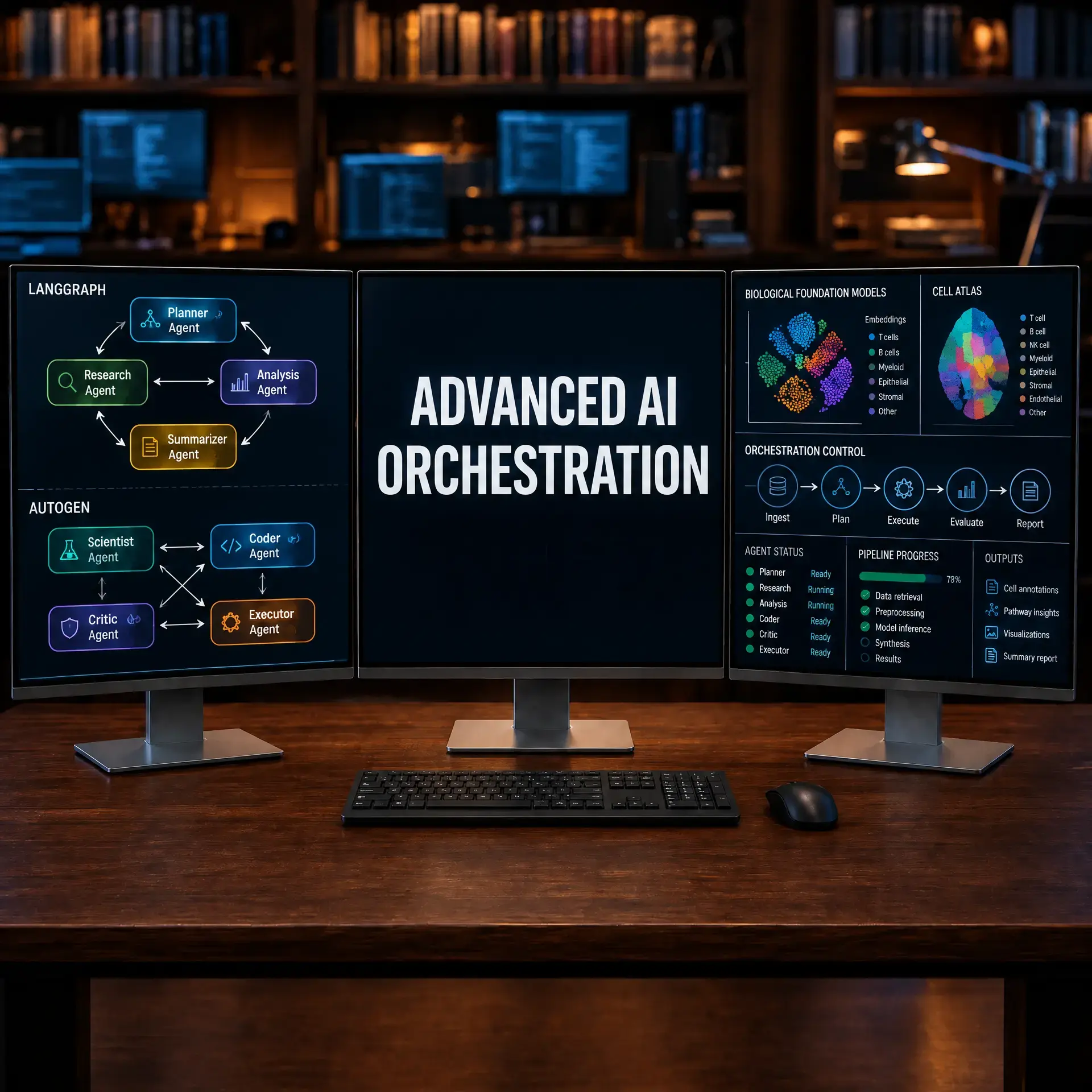
Frameworks like LangGraph and Microsoft AutoGen allow you to build multi-agent systems. Imagine a system where:
- Agent 1 (The Planner): Reads a biological research question and plans the analysis steps.
- Agent 2 (The Coder): Writes the Python/R script to execute the plan (e.g., querying the ESM API).
- Agent 3 (The Executor): Runs the script in a secure sandbox and feeds errors back to the Coder.
Example: A Simple LangGraph Workflow
Here is a conceptual example of setting up a stateful graph using LangGraph to analyze protein sequences:
from langgraph.graph import StateGraph, END
from typing import TypedDict, List

# Define the state of our graph
class AgentState(TypedDict):
    sequence: str
    code_generated: str
    execution_result: str
    errors: List[str]

def generate_analysis_code(state: AgentState):
    # Call LLM to write code analyzing the sequence
    code = llm.invoke(f"Write Python code to analyze this sequence: {state['sequence']}")
    return {"code_generated": code}

def execute_code(state: AgentState):
    # Safely execute the code (e.g., using a Docker container or local subprocess)
    try:
        result = run_in_sandbox(state['code_generated'])
        return {"execution_result": result, "errors": []}
    except Exception as e:
        return {"errors": [str(e)]}

# Build the graph
workflow = StateGraph(AgentState)
workflow.add_node("coder", generate_analysis_code)
workflow.add_node("executor", execute_code)

workflow.set_entry_point("coder")
workflow.add_edge("coder", "executor")
# If there are errors, loop back to the coder; otherwise, end.
workflow.add_conditional_edges(
    "executor",
    lambda state: "coder" if state.get("errors") else END
)

app = workflow.compile()
This graph ensures that if the generated code fails to execute, the error is passed back to the coder node for correction, creating a self-healing bioinformatics pipeline.
Conclusion
Orchestrating foundation models through agentic frameworks represents the bleeding edge of bioinformatics research. By shifting from manual scripting to building AI systems that script for you, you can drastically scale the throughput and complexity of in-silico experiments.
✅ Key Takeaways
- Multi-Agent Systems: Divide complex tasks into discrete roles (Planner, Coder, Executor) for better reliability.
- Stateful Graphs: Tools like LangGraph allow you to manage state and create cyclic workflows (e.g., write -> test -> fix).
- Scale: Orchestration allows for the high-throughput utilization of biological foundation models like ESM3 and scGPT.
What AI Orchestration Means in a Research Context
The term AI orchestration in bioinformatics refers to coordinating multiple AI components, including large language models, specialised biological AI models, and automated tool use, in a structured pipeline that can plan, execute, and evaluate multi-step research tasks. Rather than asking a model a single question and interpreting the answer manually, an orchestrated system routes queries through several agents or models, each with a defined role, and aggregates the results into a coherent output.
In practice, this can look like a system where a planning agent receives a high-level research question, decomposes it into sub-tasks, assigns each sub-task to a specialised agent (one for literature retrieval, one for database querying, one for code generation and execution), and then synthesises the results into a summary. The biology researcher interacts with the top-level system and receives integrated outputs without needing to manage each tool individually.
Concrete Use Cases in Genomics and Multi-Omics
One of the most useful current applications is variant interpretation. When a whole-exome sequencing analysis identifies a list of candidate variants, an orchestrated system can automatically query ClinVar for pathogenicity classifications, pull the associated literature from PubMed, retrieve population frequency from gnomAD, check protein domain databases for functional context, and generate a structured summary for each variant. What would take a researcher several hours of manual database querying takes the orchestrated system minutes.
A second use case is iterative single-cell analysis. A human researcher defines a broad goal, for example identifying the transcriptional programs of tumour-associated macrophages in a dataset, and the orchestrated system proposes and executes a series of analytical steps, checking the output of each step before deciding on the next. When a clustering step produces an unexpected number of clusters, the system can adjust resolution parameters and re-run without human intervention. The researcher reviews the final output rather than managing every intermediate decision.
Tool Use and Retrieval Augmented Generation
A large language model used alone has fixed knowledge that stops at its training cutoff. In a rapidly evolving field like bioinformatics, this is a significant limitation: a model trained in 2024 does not know about tools, datasets, or methods published in 2025. Retrieval augmented generation (RAG) addresses this by connecting the model to an external knowledge base that is queried at inference time. The model generates a query, the retrieval system finds the most relevant documents, and the model generates its response conditioned on those documents.
For bioinformatics, a well-designed RAG system might index your institution's preprint server, curated tool documentation, and your own project notes. When you ask the system to suggest an alignment tool for a specific organism and read type, it retrieves documentation for relevant tools, compares their stated capabilities, and generates a reasoned recommendation grounded in current tool documentation rather than training data that may be months or years out of date.
Limitations and Responsible Use
AI orchestration systems can fail in non-obvious ways. A system that automates variant interpretation may produce a confidently worded summary of a benign variant as pathogenic if the retrieval step returns an outdated or incorrect document. A code generation agent may produce syntactically correct code that produces subtly wrong results due to a misunderstood parameter. These failures are particularly dangerous when the output looks plausible and the researcher does not verify intermediate results.
The practical rule for using AI orchestration in research is to treat it as an accelerator for exploratory analysis and literature review, not as a replacement for biological judgment and manual verification of results. Always inspect intermediate outputs, validate AI-generated code against expected behaviour on test data, and cross-check AI-summarised findings against the original sources before including them in a manuscript or clinical report.
Knowledge Check & Assessment
1. Concept Verification
Why is a stateful, cyclic graph (like those built with LangGraph) superior to a simple linear chain when generating bioinformatics code?
2. Practical Execution
Draft a simple architectural diagram (on paper or using a tool) outlining a 3-agent system designed to automatically download FASTQ files from the SRA, run FastQC, and summarize the results.
Reviewed: September 2026
All commands and outputs were verified with the software versions listed in this tutorial. If you encounter reproducibility issues, please report them through the Contact page.
Author: Nasir Mahmood Abbasi, PhD · Category: AI-Driven Research & Agentic Bioinformatics